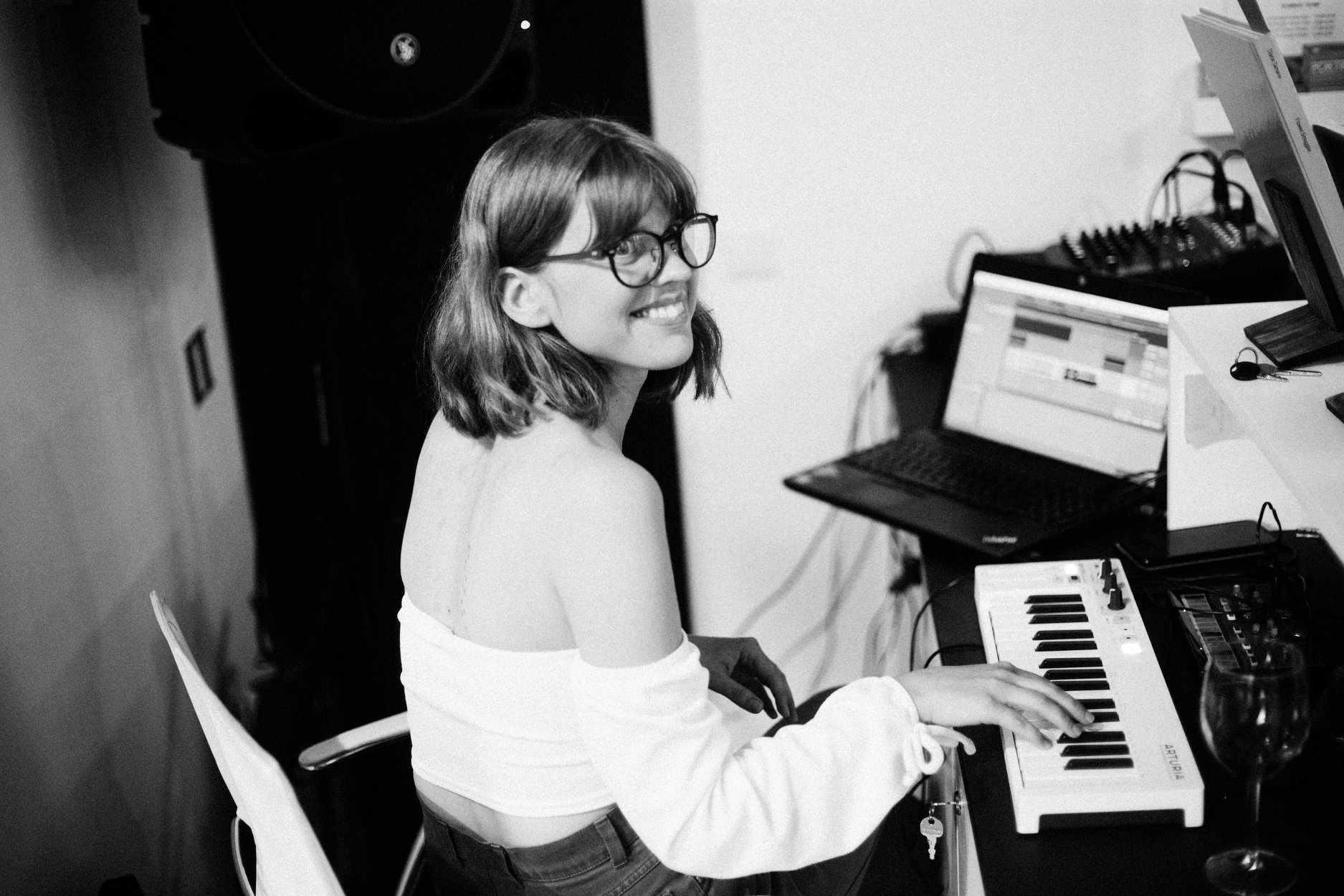
R3YWYA is a noise project created by Evija Ābrama. By improvising with sound, the artist explores communication processes and how noise becomes an integral part of space. Her works reflect an eco-acoustic approach—sounds are perceived not only as material but also as spatial relationships, where rhythm both disrupts and imitates the noises of the environment.
Can you tell us about your background and how you started making music?
All my life, I’ve been surrounded by music—or more precisely, by sound. My father has absolute pitch, and when I was little, he was on a mission to find the perfect sound system. I remember coming home from school and being asked to sit in a very specific spot in the room, because that was where the sound was at its best. He taught me to listen in a way that felt unique: not just to hear the songs, but to notice the tiniest details, the subtle textures, and the sounds that hadn’t been audible on his previous speakers. That shaped the way I experience music—not only as melody or rhythm, but as something alive, moving, and constantly transformed by technology and the way it’s mastered.
As a child, I also studied piano, mostly classical pieces, which gave me a deep love for that tradition. However, I didn’t begin creating my own music until January 2020. For a long time, I struggled with stage fright, even though I knew deep down that performing was something I wanted to do. The desire to create had always been there, even when I tried to ignore it, and eventually it grew so strong that I couldn’t hold it back anymore. It felt like the right time, especially since a few years earlier I had discovered noise music, which opened up new possibilities for me.
My beginnings were humble. I had only a Korg Volca Drum, which I bought a month before my first performance. I wasn’t satisfied with its sound, so I decided to build my own fuzz pedal. It was a quirky-looking device, assembled inside a plastic salad container. And that’s what I used at my very first show.
What does noise mean to you? How do you approach making noise and listening to it?
Noise is everything to me—it surrounds all of us. It exists everywhere, even within silence.
My approach to creating noise is deeply subconscious and physical. Noise is not just sound; it’s vibration. It moves through my body, and in a way, I become its puppet. It guides me, telling me where to go and what to do next. When I listen back to my performances, I realise how perfectly they mirror my inner world. My emotions take shape in sound, and suddenly my feelings become clearer to me.
To truly listen to noise, you have to be free and open. You have to let it enter you. Noise is one of the most primal forms of sound, which is why I believe it can serve as an international language. You cannot force yourself to hear it—you simply have to allow it to be heard.
Your work reflects an “eco-acoustic” approach—can you talk about that?
Sound is movement, and the room becomes its cage. It’s almost like ocean waves pressing against the walls, trying to escape their container. Every room carries its own acoustics and resonance, shaping the sound in unique ways. This is beautifully demonstrated in Alvin Lucier’s work, such as I Am Sitting in a Room (1969), where a recording is played back into the space and re-recorded again and again. Over time, the sound transforms—becoming less like the original and more like the room itself, moulded by its shape and the way vibrations travel within it.
As an electronic musician, I believe sound is never fixed; it always shifts depending on the space you perform in and the system that carries it. As an improvisational artist, I embrace these factors. I’m not only the creator of sound but also its listener. I try to hear how it moves through the room, how it interacts with the architecture, and how, at times, it even seems to return to me.
How does the environment influence your music-making?
Everything influences me in making music. As I’ve already mentioned—it truly is everything. The events of my life, whether recent or distant, shape the way I create. The spaces I inhabit, the environments I move through, the conversations I have, and the people I encounter all leave their mark. The world is overflowing with influence, and sound has become my way of expressing it.
Are you based in Riga? Can you talk about the city and its music scene?
Yes, I’m based in Riga. From my travels, I’ve come to realise that Riga is special because it offers space to simply be yourself—in music, art, and beyond. Many of my foreign friends have told me that in their cities, performing requires everything to be perfectly organised—with a team, planning, and high production values. But here, it’s different. In Riga, you can just walk up to a bartender and say, “Hey, can I play here sometime?” and most of the time the answer will be yes. There’s freedom here, a chance to start from scratch and grow. One of my Czech friends even said she only began performing music in Riga because here we have venues and people willing to give you space to experiment and do whatever you feel like doing.
The noise scene in Riga isn’t huge. It has its waves—there used to be more activity, and now it’s smaller—but I believe that those who continue are truly dedicated. We support each other, inviting one another to gigs, promoting each other’s work, and keeping the energy alive.
What has the future got in store for you?
I usually like to answer this with one word—fame. 😀
But honestly, what I really want is to perform outside of Riga. I like to think that I’m planting seeds now, hoping they’ll grow in the coming year.
Another dream of mine is to make an album, though I struggle with it because my music is so deeply tied to live performance. I’ve considered simply recording a 30–40-minute set, capturing the raw energy of what I do on stage. At the same time, I’m also a visual artist, and my mind demands a concept—an idea that gives the work meaning. That’s where my inner conflict lies: I want the album to be spontaneous and alive, but I also want it to carry a deeper narrative. My hope is that I’ll find a way to resolve this tension and create something physical, ideally in the form of cassettes.
My journey as an artist is only just beginning, and I feel certain that great things are ahead.
Interview Lucia Udvardyova